Airless vs Pneumatic Print & Apply Label Applicators: What’s The Difference?
When specifying an automatic print and apply labelling system, one consideration is how the applicator is powered and whether compressed air is required. Compressed air has traditionally played an important role in print and apply technology. Depending on the design, it may be used to move the applicator, create the vacuum that holds a printed label in position, or assist with transferring the label onto the product.
More recently, electrically driven applicators have reduced the amount of pneumatic equipment required, while fully airless systems can remove the need for compressed air altogether.
Neither approach is automatically right or wrong. The most suitable technology depends on the product, label size, application method, production speed, available utilities and the way the labelling system needs to interact with the production line.
View Our Range of Applicators
How Does a Traditional Pneumatic Print & Apply System Work?
In a conventional pneumatic print and apply system, compressed air can perform several jobs. A pneumatic cylinder may be used to move a tamp pad towards the product, while vacuum is used to hold the newly printed label securely on the applicator pad before it is applied.
For non-contact applications, compressed air may also be used to blow the label from the applicator onto the surface of the product. Pneumatic systems remain widely used because they can provide fast and repeatable movement and are well suited to many established print and apply applications. However, they require a suitable compressed-air supply and the amount of air required will depend heavily on the design of the applicator.
What Is an Airless Label Applicator?
A fully airless print and apply system removes the requirement for compressed air and instead uses electrically driven technology to control the application process. This can be particularly useful where compressed air is not already available at the installation point or where a business is looking to reduce its reliance on plant air.
It is important, however, to distinguish between a fully airless system and a system that simply uses less compressed air. An electrically driven applicator may remove the pneumatic cylinder traditionally used for movement while still using a small amount of compressed air elsewhere in the label-handling process. A genuinely airless solution eliminates the compressed-air connection completely.
What Are the Benefits of Reducing Compressed-Air Use?
Reducing the amount of compressed air required by a print and apply system can have several practical advantages.
It can reduce dependency on a site’s compressed-air infrastructure and may simplify installation where an airline is not already available close to the labelling point. Electrically driven movement can also provide precise control over the applicator position, speed and stroke without relying on pneumatic actuation. Where compressed air is eliminated completely, there is also no requirement to provide a compressed-air service to the machine.
That does not mean that compressed air should always be avoided. In some applications, pneumatics remain a very effective way of achieving the required label placement.
The important consideration is how efficiently compressed air is being used and whether it is necessary for the application.
Does Airless Mean Slower?
No. Airless or electrically driven does not automatically mean low-speed. The performance of a print and apply system depends on a combination of factors including applicator design, label size, product spacing, conveyor speed and the distance the applicator needs to travel.
Modern electrically driven applicators can operate on high-speed production and logistics lines, so compressed-air availability should not be used on its own to determine whether a particular system is suitable.
When Is a Pneumatic Applicator Still the Right Choice?
There are many applications where compressed air remains useful. A short-stroke pneumatic tamp can provide extremely fast and accurate label placement, particularly where products pass the applicator at a consistent height.
Compressed air is also important in some non-contact applications where the label is deliberately blown onto the product rather than physically tamped or wiped into place. For these applications, the aim is not necessarily to eliminate compressed air but to use it efficiently and only where it adds value to the application.
Not All Print & Apply Systems Use Air in the Same Way
This is where the distinction between “pneumatic” and “airless” becomes less straightforward. Some systems use compressed air for virtually all applicator movement. Others use electric motors for the movement but still require air for vacuum generation or label transfer.
There are also applicators that use very little compressed air compared with more traditional pneumatic arrangements.
So rather than thinking of print and apply technology as simply airless versus compressed air, it is often more useful to look at how much compressed air is required, what it is being used for, and whether that use is necessary for the application.
How Evolabel Reduces Reliance on Compressed Air
Evolabel is a good example of how modern print and apply technology does not fit neatly into two categories.
Across the range, different applicators use different combinations of electric movement, pneumatic movement and vacuum technology depending on the application.
Traditional pneumatic print and apply systems can rely heavily on compressed air for applicator movement and vacuum generation. Evolabel takes a different approach across much of its range, using electrically driven applicators and efficient vacuum technology to reduce compressed-air demand.
The new QuickTamp Airless takes this a step further by eliminating compressed air completely.
View The Evolabel Applicator Range
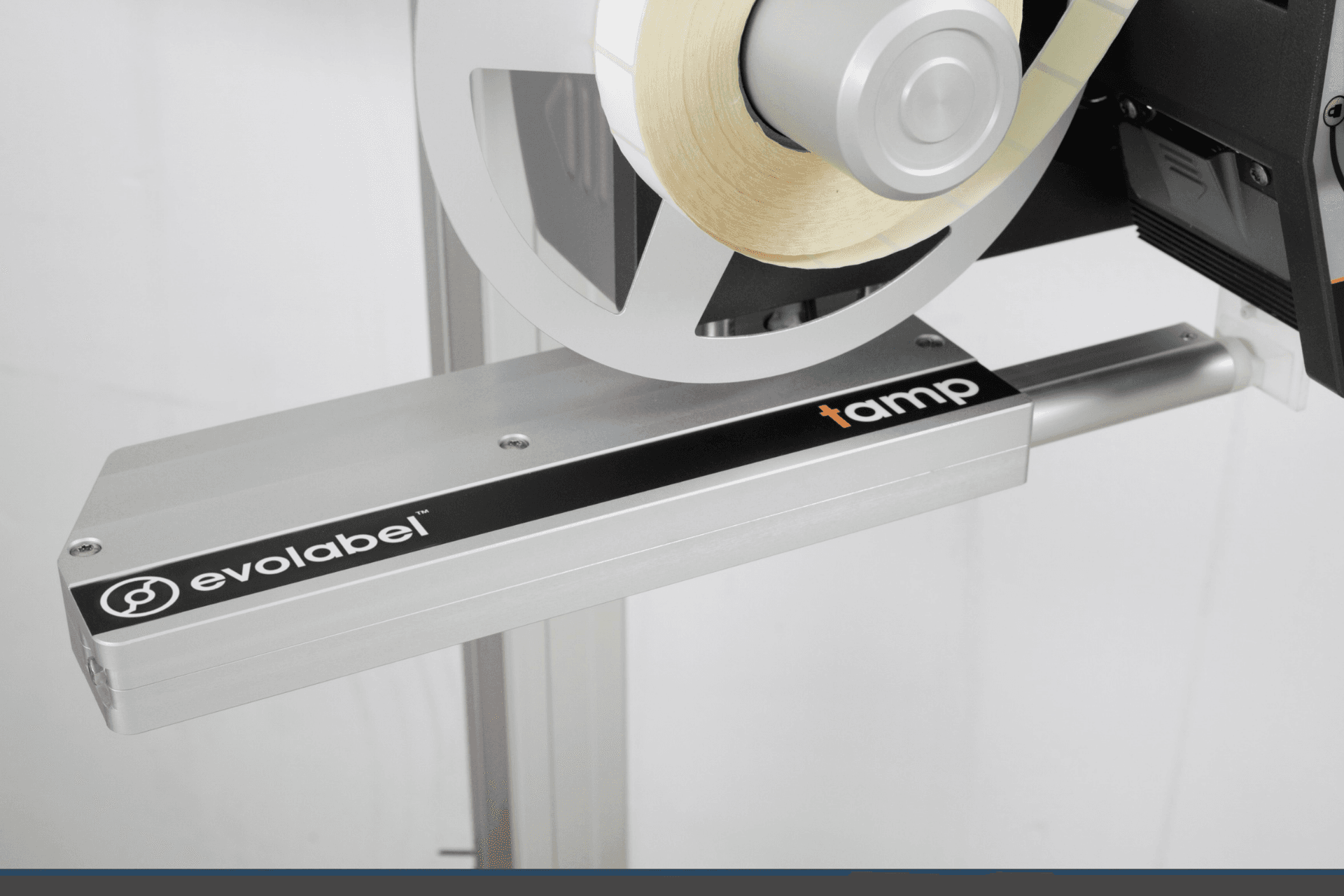
Evolabel Tamp – Pneumatic, but Designed to Minimise Air Consumption
The Evolabel Tamp is a pneumatic applicator designed for high-speed, accurate top and side labelling.
Although the applicator movement is pneumatic, Evolabel uses several independent integrated vacuum ejectors within the applicator plate. The manufacturer specifically states that this arrangement is designed to minimise air consumption while maintaining reliable label handling.
This is an important distinction: a pneumatic applicator does not necessarily have to be an inefficient user of compressed air.
Evolabel eTamp – Electric Movement Instead of Pneumatics
The Evolabel eTamp goes further by replacing pneumatic applicator movement with a stepper motor. Rather than using an air cylinder to extend and retract the applicator, the eTamp uses electrically controlled movement over stroke lengths from 150 mm upwards.
Evolabel describes the applicator as stepper motor driven instead of pneumatics, providing controlled movement for top, side and pallet labelling applications. This allows compressed-air dependency to be reduced without limiting the system to a short applicator stroke.
QuickTamp Airless – Removing Compressed Air Completely
QuickTamp Airless represents the next stage of that approach. It is a fully electric Print & Apply solution and removes the requirement for compressed air altogether. The system is designed particularly for logistics and e-commerce applications where boxes can arrive at different heights.
Evolabel specifies height variations of up to 1 metre and conveyor speeds of up to 80 metres per minute, demonstrating that removing compressed air does not mean sacrificing high-speed operation.
For sites without convenient access to plant air, this can also simplify the utilities required at the installation point.
Compressed Air Still Has a Place
Evolabel also continues to offer applicators where compressed air is an important part of the application method. The BlowVac, for example, is designed for contact-free labelling. Vacuum holds the label in position before an integrated air knife transfers it onto the product from a distance of between 50 and 150 mm.
That illustrates why there is no single technology that is right for every production line. The objective is to select the application method that best suits the product and process rather than simply choosing between “air” and “airless”.
Choosing the Right Print & Apply Applicator
When selecting an applicator, factors to consider include:
- Product shape and surface
- Label size and orientation
- Conveyor speed
- Product height variation
- Application position
- Required applicator stroke
- Contact or non-contact application
- Available installation space
- Compressed-air availability
- Production environment
At ILS, we supply the complete Print & Apply range and specify systems around the individual application rather than selecting an applicator in isolation.
That may mean a pneumatic Tamp, an electrically driven eTamp, a wipe or belt application, a contact-free BlowVac system, or a completely airless QuickTamp solution.
Get In Touch For More Information